McDonald's
revealed during its second-quarter earnings call that it has seen 12
million downloads of its application and an average check increase among
consumers who redeem mobile offers, a feat likely accomplished due to
the chain's focus on welcome incentives for new users.
Another example:
Showcasing
the sales potential for beacon-powered campaigns within supermarkets,
Hillshire Farms recently upped purchase intent for its products by 20
times after capturing more than 194,000 engagements via beacon provider
inMarket's Mobile to Mortar platform.
More;;
Find your customers. (Hint: they are mobile)
In the mobile environment, finding customers is the key to the marketing relationship.
Today’s customers have one thing in common that makes them easy to find: they are all fixated on their smartphones.
On those ever-present smartphones and mobile devices, marketers and merchants must make connections that resonate between consumers and brands, products, services and experiences.
Smartphones and tablets are incredibly powerful mobile commerce tools.
IMRG reports that 51 percent of United Kingdom sales in the last three months of 2015 were conducted on smartphones or tablets, while United States mobile commerce, according to Forrester data, is expected to reach $142 billion this year, with one-third of Web traffic and 11 percent of sales originating from smartphones.
It is growing and growing get your ap now from Rossini.com
Thursday, July 28, 2016

Tuesday, July 26, 2016
More Google stuff
More Google info
If your website is listed in Google's search results on mobile devices, your website will get many more visitors and potential customers.
More keyword info:
Modern search engine algorithms focus on topics, not on individual keywords. It is not necessary to use every possible keyword variation on your web pages (for example 'cheap travel insurance', 'cheapest travel insurance', 'cheap travel insurances', etc.).
It is much more important that the content is related to a particular topic ('cheap travel insurance', 'traveling', 'do I need a travel insurance', etc.).
More.....
Optimize many pages of your site
To get the best results, optimize different pages of your website for different search terms that are all related to the main topic of your site.
If you do that, you will make sure that your site becomes relevant to a particular topic. It will be much easier to get high rankings for the individual keywords then.
More to come soon.
Thursday, July 14, 2016
TA16-091A: Ransomware and Recent Variants
Systems Affected
Networked SystemsOverview
In early 2016, destructive ransomware variants such as Locky and Samas were observed infecting computers belonging to individuals and businesses, which included healthcare facilities and hospitals worldwide. Ransomware is a type of malicious software that infects a computer and restricts users’ access to it until a ransom is paid to unlock it.The United States Department of Homeland Security (DHS), in collaboration with Canadian Cyber Incident Response Centre (CCIRC), is releasing this Alert to provide further information on ransomware, specifically its main characteristics, its prevalence, variants that may be proliferating, and how users can prevent and mitigate against ransomware.
Description
WHAT IS RANSOMWARE?
Ransomware is a type of malware that infects computer systems, restricting users’ access to the infected systems. Ransomware variants have been observed for several years and often attempt to extort money from victims by displaying an on-screen alert. Typically, these alerts state that the user’s systems have been locked or that the user’s files have been encrypted. Users are told that unless a ransom is paid, access will not be restored. The ransom demanded from individuals varies greatly but is frequently $200–$400 dollars and must be paid in virtual currency, such as Bitcoin.Ransomware is often spread through phishing emails that contain malicious attachments or through drive-by downloading. Drive-by downloading occurs when a user unknowingly visits an infected website and then malware is downloaded and installed without the user’s knowledge.
Crypto ransomware, a malware variant that encrypts files, is spread through similar methods and has also been spread through social media, such as Web-based instant messaging applications. Additionally, newer methods of ransomware infection have been observed. For example, vulnerable Web servers have been exploited as an entry point to gain access into an organization’s network.
WHY IS IT SO EFFECTIVE?
The authors of ransomware instill fear and panic into their victims, causing them to click on a link or pay a ransom, and users systems can become infected with additional malware. Ransomware displays intimidating messages similar to those below:- “Your computer has been infected with a virus. Click here to resolve the issue.”
- “Your computer was used to visit websites with illegal content. To unlock your computer, you must pay a $100 fine.”
- “All files on your computer have been encrypted. You must pay this ransom within 72 hours to regain access to your data.”
PROLIFERATION OF VARIANTS
In 2012, Symantec, using data from a command and control (C2) server of 5,700 computers compromised in one day, estimated that approximately 2.9 percent of those compromised users paid the ransom. With an average ransom of $200, this meant malicious actors profited $33,600 per day, or $394,400 per month, from a single C2 server. These rough estimates demonstrate how profitable ransomware can be for malicious actors.This financial success has likely led to a proliferation of ransomware variants. In 2013, more destructive and lucrative ransomware variants were introduced, including Xorist, CryptorBit, and CryptoLocker. Some variants encrypt not just the files on the infected device, but also the contents of shared or networked drives. These variants are considered destructive because they encrypt users’ and organizations’ files, and render them useless until criminals receive a ransom.
In early 2016, a destructive ransomware variant, Locky, was observed infecting computers belonging to healthcare facilities and hospitals in the United States, New Zealand, and Germany. It propagates through spam emails that include malicious Microsoft Office documents or compressed attachments (e.g., .rar, .zip). The malicious attachments contain macros or JavaScript files to download Ransomware-Locky files.
Samas, another variant of destructive ransomware, was used to compromise the networks of healthcare facilities in 2016. Unlike Locky, Samas propagates through vulnerable Web servers. After the Web server was compromised, uploaded Ransomware-Samas files were used to infect the organization’s networks.
LINKS TO OTHER TYPES OF MALWARE
Systems infected with ransomware are also often infected with other malware. In the case of CryptoLocker, a user typically becomes infected by opening a malicious attachment from an email. This malicious attachment contains Upatre, a downloader, which infects the user with GameOver Zeus. GameOver Zeus is a variant of the Zeus Trojan that steals banking information and is also used to steal other types of data. Once a system is infected with GameOver Zeus, Upatre will also download CryptoLocker. Finally, CryptoLocker encrypts files on the infected system, and requests that a ransom be paid.The close ties between ransomware and other types of malware were demonstrated through the recent botnet disruption operation against GameOver Zeus, which also proved effective against CryptoLocker. In June 2014, an international law enforcement operation successfully weakened the infrastructure of both GameOver Zeus and CryptoLocker.
Impact
Ransomware not only targets home users; businesses can also become infected with ransomware, leading to negative consequences, including- temporary or permanent loss of sensitive or proprietary information,
- disruption to regular operations,
- financial losses incurred to restore systems and files, and
- potential harm to an organization’s reputation.
Solution
Infections can be devastating to an individual or organization, and recovery can be a difficult process that may require the services of a reputable data recovery specialist.US-CERT recommends that users and administrators take the following preventive measures to protect their computer networks from ransomware infection:
- Employ a data backup and recovery plan for all critical information. Perform and test regular backups to limit the impact of data or system loss and to expedite the recovery process. Note that network-connected backups can also be affected by ransomware; critical backups should be isolated from the network for optimum protection.
- Use application whitelisting to help prevent malicious software and unapproved programs from running. Application whitelisting is one of the best security strategies as it allows only specified programs to run, while blocking all others, including malicious software.
- Keep your operating system and software up-to-date with the latest patches. Vulnerable applications and operating systems are the target of most attacks. Ensuring these are patched with the latest updates greatly reduces the number of exploitable entry points available to an attacker.
- Maintain up-to-date anti-virus software, and scan all software downloaded from the internet prior to executing.
- Restrict users’ ability (permissions) to install and run unwanted software applications, and apply the principle of “Least Privilege” to all systems and services. Restricting these privileges may prevent malware from running or limit its capability to spread through the network.
- Avoid enabling macros from email attachments. If a user opens the attachment and enables macros, embedded code will execute the malware on the machine. For enterprises or organizations, it may be best to block email messages with attachments from suspicious sources. For information on safely handling email attachments, see Recognizing and Avoiding Email Scams. Follow safe practices when browsing the Web. See Good Security Habits and Safeguarding Your Data for additional details.
- Do not follow unsolicited Web links in emails. Refer to the US-CERT Security Tip on Avoiding Social Engineering and Phishing Attacks or the Security Publication on Ransomware for more information.
Thursday, June 30, 2016
SEO on the cheap is it worth it?

Although most people have understood that search engine optimization is an integral part of a successful online business, many businesses still make wrong decisions.
Here are three popular SEO offers that aren't as good as they seem:
1. Your hosting company or the CMS vendor offers SEO services
Some hosting companies and content management system vendors include 'SEO' services in their packages.In general, these offers usually include automated tools that insert keywords and other code on your web pages and then they submit your site to Google and other search engines.
Your risk: The fully automated solutions offered by many hosting companies and CMS vendors are usually outdated. Nowadays, these methods don't work anymore. In general, automatic optimization and link building is considered spam by Google.
2. A relative who is great with computers optimizes your site
Maybe you know someone who knows someone who is really great with computers. They can 'fix the SEO' on your website and you will save a lot of money because they do not charge much.
Your risk: Your relative might know how to code an HTML web page but that doesn't mean the he or she has any SEO knowledge. Not everyone who is good with numbers can do your accounting. Bad optimization can do more harm than good.
3. An offshore company will do everything for a low price
/These companies often send unsolicited emails with great-sounding offers. They promise to build backlinks, optimize your web pages and a lot more for a low monthly fee. You just have to sit back while they do the work.
Your risk: Many of the offshore companies use automated spam tools to 'promote' your website. Hiring these companies is often a sure way to get your website banned from Google in the long run. Some of these services even tweak the meta keywords tag of your web pages, which is a sure sign that they do not know what they're doing.
Better choose a reliable solution that leads to lasting resultsIf you want to build a successful online business, it is much better to develop a long-term search engine optimization strategy. You will save a lot of money because you will get much better results.
We offer affordable SEO marketing that works!
Friday, June 24, 2016
The case of Fridayatosisbordaltosis!
Ok what does my title mean you ask? Wllevery once in a while I get tired and bored and well sometimes just cant seem to get going. lately with all the heat it seems everyone has started to take a long summer nap. In Europe many countries take 90 days off, can you believe it a summer holiday! How do those people pay their bills? Well their health care is usually taken care of by the government scratch anywhere from $500.00 to $5000 a month! We usually work 50 to 60 hours a week minimum so that takes up a lot of time. I just guess right now we are just coasting. It is good to coast occationally to take a deep breath and cough cause our air might not be totally clean but we at least should take a day or so off like I have today mostly and relax. I will write more soon after my Fridiatosis goes away! :)
Joe
Joe
Wednesday, June 22, 2016
More Google stuff
Google Search Console has quietly added a feature within the Search Analytics report to filter data based on “rich results.”
Rich results are when your pages show up in the search results as rich cards or other forms of rich snippets. The report gives you a better sense of how many impressions and clicks you get for rich results and how the click-through rate might differ compared to normal search results.
Here is a screen shot showing the rich results filter within the search appearance option:

At Google I/O, we saw proof that this type of filter was coming, and now it is here. Google did add the AMP filter to that report some time ago.
Google has not yet announced the rich results filter availability in this report, but you should be able to see it.
More to come soon!
Joe
Rich results are when your pages show up in the search results as rich cards or other forms of rich snippets. The report gives you a better sense of how many impressions and clicks you get for rich results and how the click-through rate might differ compared to normal search results.
Here is a screen shot showing the rich results filter within the search appearance option:
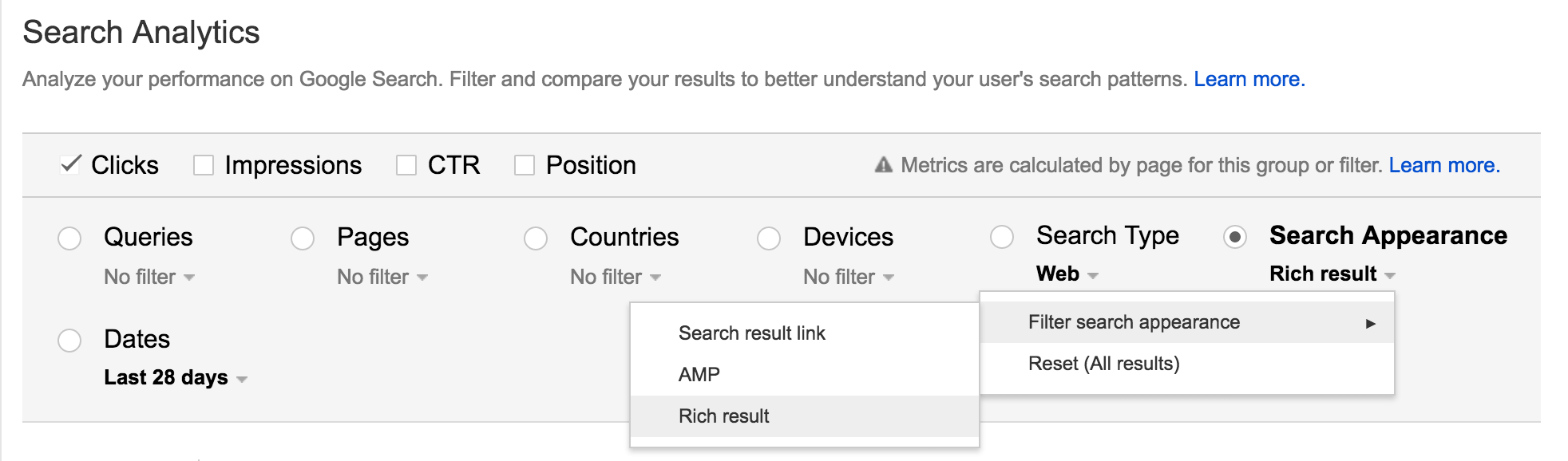
At Google I/O, we saw proof that this type of filter was coming, and now it is here. Google did add the AMP filter to that report some time ago.
Google has not yet announced the rich results filter availability in this report, but you should be able to see it.
More to come soon!
Joe
SEO make the right choice!!
Here are three popular SEO offers that aren't as good as they seem:
In general, these offers usually include automated tools that insert keywords and other code on your web pages and then they submit your site to Google and other search engines.
If you want to build a successful online business, it is much better to develop a long-term search engine optimization strategy. You will save a lot of money because you will get much better results.
Bottom line this info from Axandra is so on the mark. I have delt with companies that hire youngsters who know WordPress and some other things and wallah they are experts leading you down the rosy path of mistakes. To do it right yu have to seek experience and frankly be prepared to pay for it.
More to come
Joe
1. Your hosting company or the CMS vendor offers SEO services
Some hosting companies and content management system vendors include 'SEO' services in their packages.In general, these offers usually include automated tools that insert keywords and other code on your web pages and then they submit your site to Google and other search engines.
Your risk:
The fully automated solutions offered by many hosting companies and CMS
vendors are usually outdated. Nowadays, these methods don't work
anymore. In general, automatic optimization and link building is
considered spam by Google.
2. A relative who is great with computers optimizes your site
Maybe
you know someone who knows someone who is really great with computers.
They can 'fix the SEO' on your website and you will save a lot of money
because they do not charge much.
Your risk: Your
relative might know how to code an HTML web page but that doesn't mean
the he or she has any SEO knowledge. Not everyone who is good with
numbers can do your accounting. Bad optimization can do more harm than
good.
3. An offshore company will do everything for a low price
These
companies often send unsolicited emails with great-sounding offers.
They promise to build backlinks, optimize your web pages and a lot more
for a low monthly fee. You just have to sit back while they do the work.
Your risk: Many
of the offshore companies use automated spam tools to 'promote' your
website. Hiring these companies is often a sure way to get your website
banned from Google in the long run. Some of these services even tweak
the meta keywords tag of your web pages, which is a sure sign that they
do not know what they're doing.
Better choose a reliable solution that leads to lasting resultsIf you want to build a successful online business, it is much better to develop a long-term search engine optimization strategy. You will save a lot of money because you will get much better results.
Bottom line this info from Axandra is so on the mark. I have delt with companies that hire youngsters who know WordPress and some other things and wallah they are experts leading you down the rosy path of mistakes. To do it right yu have to seek experience and frankly be prepared to pay for it.
More to come
Joe
Subscribe to:
Posts (Atom)